Module 3: Methodology
It was a challenge on the topic of mapping and what questions would follow of Module 3. I had chosen the topic of Mapping and within Mapping I chose the subject of Data Tracking. The definition of Data Tracking is collecting data from individuals and then analyzing it.
For my project, I gave examples of Data Tracking which are cookies, terms and conditions, and pop-up advertisements. A while ago, I made three surveys for the class. I asked how they felt about advertisements on their device, if they received personalized advertising, then inquired if they liked the content the advertisers were showing. In my presentation, I gave a scenario of how advertisers could affect and influence a person (me) and their spending habits. I provided information of how to reduce cookies and read the policies of the applications that do carry Data Tracking programs. In the same slide, I have put research information about the five states that have laws against Data Tracking including Virginia.
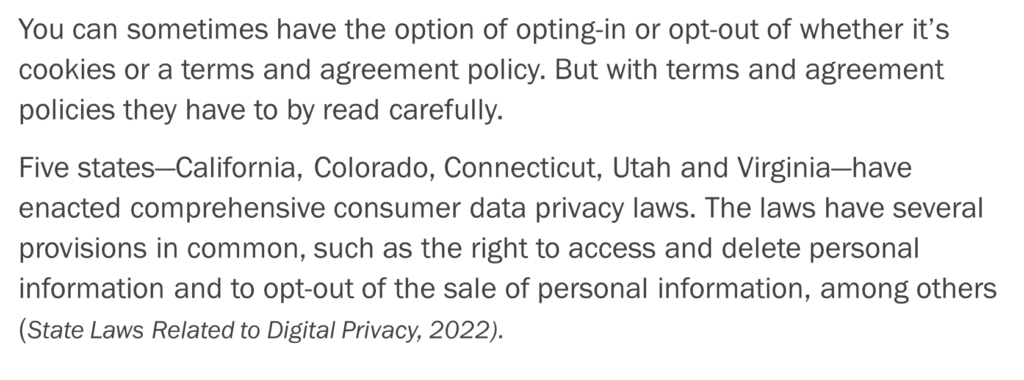
In my presentation I should have included how Data Tracking can be used in a beneficial way or a least in a neutral understanding such as banking and making purchases with a credit card. I should have talked about and included how Data Tracking can be useful to companies, small and large. I should have taken into both parts of Data Tracking, not just the advertising prospect of it.
Thank you for reading my post, goodbye!
Digital Archeology Project
The class had a project to do and find pieces or components of some obsolete technology and research where it was made in, the country and the company. I did this project in a team with Jaiden, and we chose for our Digital Archeology project, my old iPad mini. I offered my iPad mini since it had limited abilities left on the platform since it had no updates available (and also because I have forgotten, I do not know the passcode). We did not tear apart the tablet as other groups did in the classroom, instead we research the components and parts inside the iPad mini. It wasn’t easy, the research of the project was difficult, yet we found the list of parts and components on Apple Support website page. It listed the items that we were looking for the Lithium-ion battery, the iSight camera, the accelerometer, the A5 chip, and the Graphics Processor Unit (GPU).
I wish I could have explanations for what each component does, such as the Lithium battery stores the charge for the device. The iSight camera is on the back of the iPad mini and takes higher-quality pictures than the front camera. The accelerometer functions as a gyroscope, determining the movement. The GPU supports the graphics on the device. The A5 chip is an image signal processor unit. I did although it was tricky, track and find where the iPad minis were assembled and built. The iPad minis were made by Foxconn and Pegatron.
In the class when it came to be our turns to present our project. I didn’t do much speaking, but I passed around the old tablet to classmates. Jaiden did most of the speaking. I think we were allotted two minutes for our presentation not including questions from the class. Looking back, I think I really enjoyed working on this project.
Module 2: Culture
My topic for the Module 2 was Personal Data Tracking. For personal data tracking, I mainly focused on the physical objects that would track personal location and habits, and can sell the personal data to third parties. I touched upon my experience with a fitness tracker, my Fitbit, it was more of a pedometer really, it wasn’t that advanced if I wanted my steps to be counted, I would have had to sync it into my tablet on the app only then could I know my number of steps taken in the day. (Yet with technology advancing every day, my mother has an accessory smartwatch that pairs to her phone within seconds.) Newer smartwatches have GPS which means a person could go anyway, and far away a data center will know the exact location just by coordinates. I should have spoken more about the smart devices used in home and offices. I could have discussed more in dept about an article about these two reporters and how one resided in the smart home while the other hack and took some of data from the household. However, I did talk about the devices and the company picks up and sells the information to a data broker. I did define what a data broker is, it is a single person or company that collects personal data on an individual and sells the information to a third party. I did very briefly discuss the topic of how people can avoid being data tracked, one easy, yet time-consuming way would be to read the Terms and Agreement and The Privacy Policy before purchasing and/or installing the item.
I did not get to the research about the encryption of the smart devices before my presentation. Amazon has said that it has both the Echo devices’ data and Alexa encrypted then safely stored in the cloud. Apple also said that its smart home communications are encrypted as well. I do not know about the other smart devices that were mentioned because the authors did not tell the readers what brands they were using for their study at that time. This article I used is from Gizmodo called The House that Spied on Me by Kashmir Hill and Surya Mattu.
I hope this summarizes my topic of Personal Tracking Data for Module 2. Thank you for reading and goodbye!
Introduction
Hi! My name is Kate. I created this platform through the use of the University of Mary Washington. This is my first website I created. I can’t wait to share this website with you. My hope and goal are to learn about the various uses of internet, such as social media in the ways people connect and influence, and new technologies that develops our world today and for tomorrow.
Module 1: Creativity
My goal for this module was to explain DIY or do-it-yourself thoroughly to my peers. The finished product was a PowerPoint that detailed and described the topic of DIY from creating home furnishing, decorations and art projects to home repairs and home remodeling. I couldn’t have had the history without the use of United Kingdom’s Science Museum’s website and United Kingdom’s Country Living website. I know I should have spoken up and clearly for everyone to hear me when I was presenting and should have also posted a link for one of my favorite DIY videos. Overall, I think the presentation went well, after all people have been toiling and tinkering for thousands of years, I think this is all I can say for now. Thank you for reading my post!
